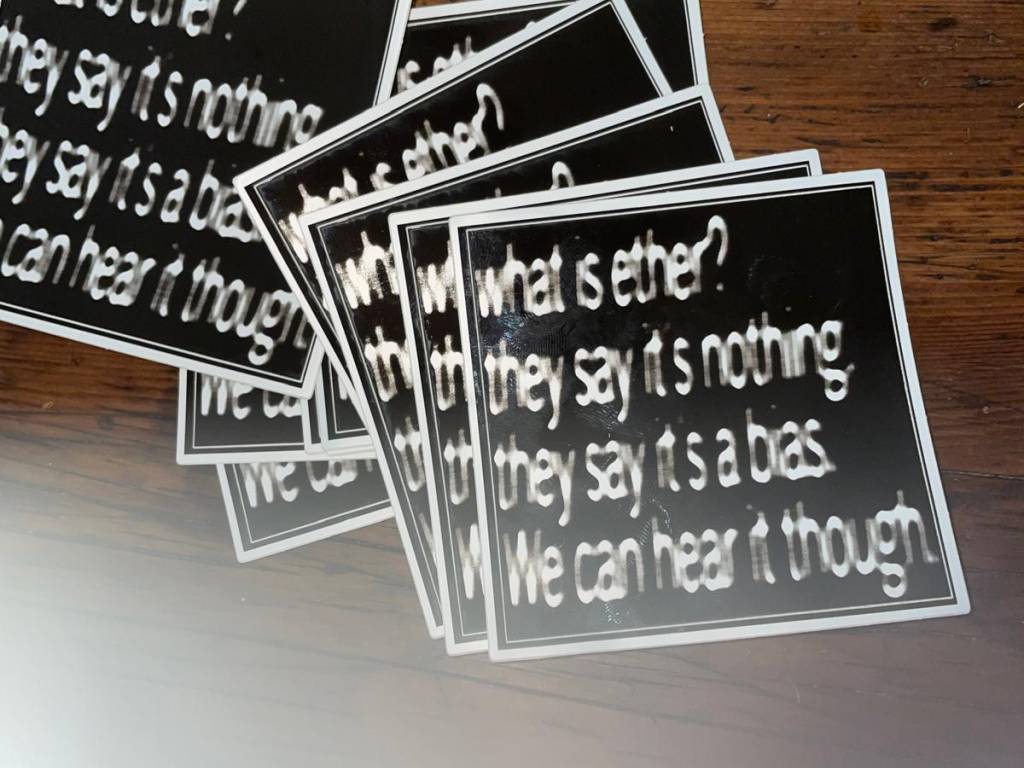
What is ether?
Text: Urs Rihs | Translation & Voice Recording: Robin Zurbrügg
A small band of euphoric radio spirits from Bern asked themselves in 2016: «What is ether?» – and founded the community station Radio Bollwerk. Ten years later: one possible answer, delivered as a birthday speech.
What is ether?
It must have been very quiet, after all the witches had been burned in God's name and the iconoclasm of Reformation exorcised the last of the spirits. Malleus Maleficarum was written by the Dominican friar Heinrich Kramer in 1486. The book, a manual for the European persecution of witches, which reached its utmost brutality in the 16th and 17th centuries. The dawning age of reason was baptized in blood. The hounding of magic, misgivings, and monsters had been perpetrated by both religion and reason, while its execution fell to profane courts. Industrialization led then to the fall of even the guardian angels. Now the machines were to help.
Reason believed to have had the last word. Electrified and assured it could fathom anything. Having overcome belief itself and attained superiority over the world, one was pulled toward the supernatural. Séances were held, the Ghost Club was founded in London in 1882. And when they eavesdropped through the door of the dead using their downturned glasses as stethoscopes, the likes of Marie Curie and Victor Hugo gladly joined – the arts, sciences and politics. It was expected of dandies and intellectuals. The wall separating realization and illusion was torn down in ethereal whispers before it had ever been properly built. The circle was complete. A shadow world arose where measurement could not see. With it, among other things, anthroposophy, the astral form and aura.
A preemptive reaction, perhaps, to the horrors of modernity that were to come. Progress' linear dogma had set its sights on the uncontrollable. Or better yet, its attempted integration, leading to its production. Science seemed, at the time, expandable, especially through esoteric teachings and promises from distant worlds. Even the beyond was to become of this world. Reformation and esotericism, not as a counter to technological progress, but as its dowry – a conjunction of opposing forces, not a contradiction. Those, today, who still assume it was solely a case of disenchantment miss the central insight: The inexorable brightening of electric light begets a darkroom.
Can this rise in occultism – or spiritism – be read as an attempt to objectively record the paranormal? Thunder rolled and lightning struck, courage and pride arced between brain and machine. And suddenly, as the century turned, a new medium rang out through the clouds: Radio. The first broadcasts, a reminder of magic. Music and voices suddenly sang from boxes, with them never-before-heard sounds. More than a few believed, euphorically, in the possibility of telepathy in the near future. After all, waves broadcast voices sans bodies. Telepathy as a fetish. An idea with staying power - the present-day imagining of singularity, a fusion of consciousness and computer. But back to radio, one after the other.
With experiments by Popow, Tesla, and Marconi in wireless transmission and with the proof of electromagnetic waves by Hertz – the spaces in between heaven and earth were repopulated. Air began to vibrate and materialized acoustically: An almost tangible static washed away the silence. And with it, an ancient idea seemed to have found its confirmation, the idea of a worldwide medium for transmission, matter that surrounded the world: Ether. The concept was already known in antiquity, "Ether" comes from the Greek word for "blue sky". In the early modern era, Descartes and Newton had used it to explain light's travels.
Yet it was that they were wrong. Physics at the beginning of the 20th century had broken with the idea of ether as a mediator. Einstein no longer needed it for light. Light traveled through vacuum independently of ether. And still, the term resurfaced later with Einstein. Radio remains a context wherein ether has lived on. As if it was immune to the effects of facts. June 8th, 1821, in Königs Wusterhausen near Berlin, the first opera was put on the air, nay, sent to the ether. Using antennas the size of miniature Eiffel Towers, Puccini's Madame Butterfly. Even if, at the time, the receiving of radio broadcasts was prohibited, reserved for military use. Despite this, the opera was received for hundreds of kilometers. Madame Butterfly was a pre-memory: Radio's temptation was never again to be withstood.
Radio's popularity was to explode: 1924, "Zauberei auf dem Sender", the first German radio play. 1930 saw Bertolt Brecht ready with his first media theory of radio: In the hopes of turning receivers into simultaneous broadcasters – active, not merely consuming – but, alas, this was still to be a long way off. However, the modern dictators were quick to exploit the mass-medium. Through the glowing cat's eye of the radio set, they sit in every parlor and speak to their subjects in their homes. Trust and desire arise largely by ear. Perhaps there is reason balance is perched there as a watcher as well. 1938 brings Orson Welles' War of the Worlds. Its realism has been said to have caused a panic in the USA. Manipulation of perception by radio. Fake News in the age of its broadcastability was born. Even news of the alleged panic was news – news of news.
The postwar era saw radio become more independent and defiant: less voice of state, more mobile, roving, airborne transmitters – even on the high seas. Subversion and protest – radio as activism. In urban centers and postcolonial states, voices make themselves heard with autonomous stations. "Radio Rebelde" in Cuba, or "La Voix de l'Algerie combattante" are its most famous representatives. Radio as organizational structure with the goal of equality. Even the mere longing to make freedom heard is potential enough. And this potential was not abstract: January 9th, 1979, 10:15, Radio Città Futura is attacked by fascists. The station isn't broadcasting propaganda. Rather, the feminist "Radio Donna" is running a program on everyday issues facing women, specifically, this morning, about contraception. As luck would have it, the five women present survived, albeit gravely injured.
Parallel to the politicization of radio, the medium develops as a medium of the avant-garde. From the fifties onward, reportage and sonic experimentation are wed to musique concrète to create the first sound-art. Afterwards, radio spreads to the realms of culture and education. A certain calm sets in. Television takes the main stage while radio becomes mundane and relevant. Countless stations are founded, including for the broader society. Radio 24 greets Switzerland from atop Monte Ceneri. Commercialization sets in. By the 1990s, radio has become one big celebration of affluence.
The Aughts bring turmoil, establishing a sense of anything goes and slowly but decisively degrading the feeling of linear progression: anything can ebb and flow. Neoconservative talk-radio hosts profit off of the deregulation of radio: As the Fairness Doctrine falls under Reagan, broadcasters are freed from the obligation of impartiality and balance. Bound by no standards, demagogues preach fire and brimstone, hearkening back to Baptist tent revivals and becoming guiding stars to the post-industrial working class. All the while, the first podcasts appear online. Radio is made personal: a revolution. The 2010s bring a veritable podcasting boom, and Brecht's initial hope of active receivers materializes partly through direct participation via chat.
Then, London, April 2011, Femi Adeyemi launches the internet radio station NTS and critically shapes the musical tastes of Western metropolises. The urban, creative elite now listen to curated web radio. This quickly becomes a subculture, with all of its codes. Country alongside hardcore techno is no contradiction. Nor that this diversity produces its own kitsch, a global homogenization of listening habits in urban centers under the drumbeat of curation. Radio has long since overtaken its magical echo: Whether it holds its ground as niche, or prefigures the tastes of the many, it has emancipated itself from wonder. Radio no longer needs the theory of the ether.
"What is ether?"
a small band of euphoric radio spirits from Bern once asked in 2016.
"They say it's nothing, they say it's a bias."
We can hear it, though.
Radio Bollwerk – a community radio and beyond.